There's so many big stories this week and so little regarding economics and finance, we've been hesitant to really spend much time getting into the fray.
You got the Bengazi situation from last year coming back into focus for at least another week or so, the IRS admitting they targeted both Conservative and Jewish organizations with unfair bias when applying for tax-exempt status, and Associated Press claiming the government seized phone records over a two month period in 2012 in a probe to see how they gather their news in the wake of a CIA operation in Yemen...
Wheww~
The problem with most news like this is that nothing ever comes about..
No prosecutions.. No voluntary resignations.. No impeachments..
There's some hubbub and rigmarole to incite partisan passions and then the weekend rolls around and all everyone is concerned about is Memorial Day weekend preparations and the symbolic beginning of 'summer fun'.
Oh trust us-- we wish and hope any or all of these three situations blow up into a mighty political dust-cloud.. preferably so large it gets into the eyes of and badly stings n' blinds Wall Street.
Of course if the final result of all this is a 'President Joseph Biden', that's not That much for political enemies of the President to celebrate, is it?
If we had to focus on one of the three current stories making the rounds, we'll take on the most dry topic-- IRS. Always a challenge to see if one can make dry toast taste like a warm buttery croissant..
What makes what the IRS (and whoever instructed them) so evil isn't merely the targeting of groups from a political or religious affiliation, but the combination of stall tactics and deep intrusion via the questioning to make the applying for tax-exempt status as sadistic as possible.
According to the DailyMail UK, one Tea Party group, the Richmond Tea Party was asked 55 questions after more than two years for waiting... Fifty-Five!
Here's a mere sampling:
3) Provide the following information for all the events and programs you have conducted and participated from October 22,2010 to now (other than the events and programs that are questioned below separately). Please answer the following for each event:
a) The time, location, and detailed description of each event or program
b) Copies of handouts you provided to the audience, participants, and the public
c) The names and credentials of the organizers
d) If speeches or forums were conducted in the event or program, provide detailed contents of the speeches or forums, names of the speakers or panels, and their credentials. If any speakers or panel members were paid, provide the amount were paid for each person. If not, please indicate they volunteered to conduct the event or program.
e) The names of persons from your organization and the amount of time they spent on the event or program. Indicate the name and amount of time they spent on the event or program.
f) Indicate the name and amount of compensation that were paid to each person' If no one were paid, indicate this event were conducted by volunteers to each person. Indicate the percentage of time and resources you spent on all the events and programs in relation to 100% of all your activities.
g) Will your near future events and programs remain similar to those you have been conducting recently? If not, explain the changes of your events and programs in the near future in terms of contents, time, and resources.
Indicate.. Indicate.. Indicate!!
Marsha.. Marsha.. Marsha!! (Brady Bunch reference there)
Now when President Obama's brother Malik applied for tax exempt status to the Barak H. Obama Foundation, senior IRS official Lois Lerner granted it rather quickly...
How quick? 18 months? 12? maybe 6?
Nope-- 1 month.
Lerner also appears to have broken with the norms of tax-exemption approval by granting retroactive tax-exempt status to Malik Obama’s organization.
From DailyCaller:
"Lerner granted the organization a 501(c) determination and even gave it a retroactive tax exemption dating back to December 2008.
The group’s available paperwork suggests an extremely hurried application and approval process. For example, the group’s 990 filings for 2008 and 2009 were submitted to the IRS on May 30, 2011, and its 2010 filing was submitted on May 23, 2011.
Lerner signed the group’s approval [pdf] on June 26, 2011.
It is illegal to operate for longer than 27 months without an IRS determination and solicit tax-deductible contributions."
The ostensibly Arlington, Va.-based charity was not even registered in Virginia despite the foundation’s website including a donation button that claimed tax-exempt status.
A little background on Abon’go “Roy’ Malik Obama-- He is Barack Obama’s half-brother and was the best man at his wedding, and he has a checkered past. In addition to running his charity, Malikran unsuccessfully to be the governor of Siaya County in Kenya.
He was accused of being a wife beater and seducing the newest of his twelve wives while she was a 17-year-old school girl.
So Lerner approves tax-exempt status for that Foundation in one month and retrogrades it by 36 months, but will ask the Richmond Tea Party this:
10)Are you a membership organization? If so, provide the following for your membership.
a) How many members do you have currently?
b) What does the memberships consist of? Are they mostly individuals? What is the percentage of the organizational members as they are part of the whole membership?
c) Provide member application/registration form
d) Provide membership agreement and rules that governs members.
e) Provide a membership fee schedule.
f) What are the membership requirements?
g) What services and benefits do you provide especially for members only?
h) What are the roles and duties of your members?
i) Provide copies of your website that your members can only access.
In a free society like ours it is truly unacceptable for any group of people to be targeted in this way based on mere ideological opinions. But in a way its not surprising..
Government is paranoid... So desperately afraid of any force(s) threatening its power. Remember- you work for its benefit, not it working for yours.
And when the Dept of Homeland Security buys 10s of thousands of automatic weapons and hundreds of thousands of bullets to arm local police, trust us,its not to fight an enemy thousands of miles away.
Like we said, we hope this turns into something Big... We Hope lots of head will roll for this.. Major repercussions...
But we've been burnt so many times..
So for now, we'll just sit back and observe while not being tempted by the enticing possibility of sparks turning into gorgeous wildfire...
And think on happy things.. Like cats and piggies
Showing posts with label Cat. Show all posts
Wednesday, May 15, 2013
Sunday, February 5, 2012
White Tiger
True Wild Life | White Tiger | The white tigers originated in the pure Bengal strain in India. Later in captivity Siberian was crossed in to make a bigger more impressive white tiger. They do have some pigment, so they are not albinos. The white tiger has a shorter life expectancy than the orange tiger, thought to be due to the white tigers mutated genes and to the inbreeding depression necessary to perpetuate the bloodline. The white tiger was always rare to come across in the wild in India, and none have been seen in the wild for over 50 years. The gene that causes the background to be white is a simple recessive. For that reason to produce whites they must be mated either to other whites or to normal orange tigers that are carriers of the white gene. The white tiger has been known to give birth to an orange tiger when mated to an orange male. Cubs of both colors occur in the same litter.
White tigers have also sadly appealed to those who are rich who either display the white tiger in captivity or killed the white tigers for their fur. For that reason white tigers are no longer seen in the wild. All were captured for captive breeding programs or killed as trophies for rich hunters. It has been speculated that some white tiger individuals are born with a blue tinge to their black stripes. Although this has not been recorded, it is possible for a genetic mutation to occur diluting the black stripes of the white tiger a blue/gray color. This dilution of black to blue is common in horses, cats, and dogs.
As white tigers are simply a different coloured version of the normal orange tiger, there are very few differences (if any at all) in the white tiger's behaviour. The white tiger lived in a jungle habitat where there was plenty of cover for the white tiger to remain hidden and to keep on the look out for potential prey. However, they did tend to stand out against their backgrounds and did not camofluage as effectively as normal orange tigers
The tiger is a carnivorous mammal and a fearless predator hunting large mammals including deer, wild boar and cattle. Tigers are extremely stealthy animals and are able to sneak up on their prey and catch it off guard. This makes the tiger a ruthless and dominant predator within its environment. The tiger is a solitary animal and it requires a large territory in order to ensure that there is an adequate food supply. Tiger cubs remain with their mother until they are strong enough and experienced enough to hunt for themselves.
Saturday, November 5, 2011
Snow Leopard
True Wild Life | Snow Leopard | The snow leopard is a moderately large cat native to the mountain ranges of South Asia and Central Asia. Although sharing its name with the common leopard, the snow leopard is not believed to be closely related to the Leopard or the other members of the Pantherine group and is classified as the sole member of the genus Uncia uncia. The classification of this species has been subject to change and its exact taxonomic position will not be resolved until further studies are conducted.
Snow leopards live between 3,000 and 5,500 metres above sea level in the rocky mountain ranges of Central and South Asia. Their secretive nature means that their exact numbers are unknown, but it has been estimated that between 3,500 and 7,000 snow leopards exist in the wild and between 600 and 700 in zoos worldwide.
Snow leopards are carnivores and actively hunt their prey, though, like all cats, they are opportunistic feeders, eating whatever meat they can find, including carrion and domestic livestock. The Snow Leopard eats goats, sheep, rabbits and birds. It can catch prey over 3 times its own weight!
At one time, the Snow Leopard was nearly hunted into disappearance for its fur. Its rare, beautiful fur could sell for a very high price. Now, conservation actions, for the Snow Leopard's numbers are slowly becoming popular. Sadly, the hunters kill the leopard for its fur, and some leopards are killed by people to protect domestic goats.
Iberian Lynx
True Wild Life | Iberian Lynx | The Iberian lynx also known as Spanish lynx is a critically endangered species native to the Iberian Peninsula in Southern Europe. It is one of the most endangered cat species in the world. The species used to be classified as a subspecies of the Eurasian Lynx, but is now considered a separate species. Both species occurred together in central Europe in the Pleistocene epoch, being separated by habitat choice. Iberian lynx resembles other species of lynx, with a short tail, tufted ears and a ruff of fur beneath the chin. Iberian lynx has leopard-like spots with a coat that is often light grey or various shades of light brownish-yellow. The coat is also noticeably shorter than in other lynxes, which are typically adapted to colder environments.
In spite of its strong resemblance to the Eurasian Lynx, the Iberian Lynx has a smaller body and the facial features of a house cat. Iberian lynx typically hunts smaller animals, usually no larger than hares. It also differs in habitat choice, with Iberian lynx inhabiting open scrub and Eurasian lynx inhabiting forests.
The Iberian Lynx must really like rabbit because it accounts for an amazing 80% of their diet. They also eat young deer and duck. At one time, rabbits disappeared due to an epidemic outbreak and the number of Iberian Lynx plummeted. This is because rabbits are its main food. Today, development continues to destroy forest environments and could trigger another decline in rabbits. If that happens, it will cause irreparable damage to the already scarce population of Iberian Lynx.
There are only a few forests in Spain and Portugal where the remaining Iberian Lynx live, making them one of the most critically endangered species of the Felidae family. Forest development is one of the main reasons they have become so rare. Their habitat has diminished and they live sporadically due to roads and towns being built in the forest. Further damage comes from poachers who continue to violate bans on their hunting.
Saturday, March 26, 2011
Tiger
True Wild Life | Tiger | The tiger is the largest feline in the world, with the tiger growing to around 2.5 metres in length. The tiger is the most powerful of all the big cats, and is native to east and southern Asia. The tiger is feared by most human beings who inhabit settlements within the tiger's territory. There are six different subspecies of tiger which are the Bengal tiger, the Indochinese tiger, the Malayan tiger, the Sumatran tiger, the Siberian tiger and the South China Tiger. The white tiger is actually a Bengal tiger and is therefore not a subspecies itself.
The average tiger weighs around 300kg and a tiger can stretch its body (and tail) to roughly 4 metres. Tigers hunt snakes, boar, buffalo, crocodiles, deer, leopards and camels and are extremely effective at catching their prey due to their silent, stalking approach and their powerful bodies. The tiger can reach speeds of up to 90km an hour, making the tiger extremely fast. Tigers have even been known to conflict with rhinos and elephants with the tiger generally winning.
Tigers are generally orange with black stripes although it's common to get tigers with white and sandy coloured markings. The white tiger is a rare type of tiger, with bright white fur and black stripes, these tigers occur from a genetic mutation when in the mother tiger's womb. It is not certain that these white tigers will produce white offspring, many white tigers have been known to produce orange cubs. Today the tiger is a near endangered species with only a handful still roaming the Asian jungles. The tiger is still a completely dominant predator in it's environment particularly due to their extreme power, and ability to run, swim, jump and climb trees very effectively.
The tiger is a highly adaptable animal with the tiger's territory ranging from Siberia, to open grasslands and tropical mangrove swamps in central and south-east Asia. The tiger is also an extremely territorial animal and the tiger is generally a solitary animal. Due to the tiger's size and the tiger's want to be solitary, the tiger often requires large areas of habitat that can support the tiger's prey demands. Because of the tiger's need for a large territory mixed with the fact that the tiger is native to some of the more densely populated places on earth, has meant that there have been significant conflicts between tigers and humans.
Tigers usually mate from November to April and after a gestation period of just over 3 months, the female tiger gives birth to 2 or 3 tiger cubs. When the tiger cubs are first born they are blind and extremely vulnerable. By the time the tiger cubs is around 18 months old, it is able to hunt for itself. Tiger cubs are known to grow rapidly and can put on 100 g of weight every day. The tiger cubs usually stay with their mother until they are between 2 and 3 years old and the tiger cubs are then big enough and strong enough to venture out into the jungle to live a life of solitude.
Wednesday, March 23, 2011
Sumatran Tiger
True Wild Life | Sumatran Tiger | The Sumatran tiger is the smallest subspecies of tiger in the world, with male Sumatran tigers rarely growing to 2.5 meters in length. The Sumatran tiger is today a critically endangered species of tiger with only around 500 thought to be in the wild. The Sumatran tiger is natively found only on the Indonesian island of Sumatra where the Sumatran tiger can be found inhabiting a variety of habitats from low and highland areas, to mountainous jungle and peat swamp forests.
The is Sumatran tiger the smallest species of tiger meaning that the Sumatran tiger is able to move through dense jungle with greater ease than it's larger cousins. The Sumatran tiger is quite different in appearance to other tiger species as the stripes of the Sumatran tiger are narrower than those of other tiger species and they also have larger manes. Sumatran tigers have slightly webbed paws which allows them to swim more efficiently after their prey.
The Sumatran tiger is a dominant and carnivorous predator, hunting it's prey by stalking it until the Sumatran tiger has the opportunity to catch it off guard. Sumatran tigers primarily hunt larger mammals including deer, wild boar, cattle and goats. Due to the size and power of the Sumatran tiger, it has no natural predators in its native environment. Humans that hunt the Sumatran tiger and habitat loss are the only threats to the Sumatran tiger.
After a gestation period of 3 to 4 months, the female Sumatran tiger gives birth to up to 5 cubs. Newborn Sumatran tiger cubs weigh about 1 kg (2 lb) and are blind and helpless. The mother feeds them milk for about 2 months and then the Sumatran tiger cubs are introduced to meat. Sumatran tiger cubs depend on their mother for the first 18 months and then they start hunting on their own. Today, due to habitat loss caused by deforestation, and hunting by human poachers, the Sumatran tiger is considered to be a critically endangered species. Modern estimates suggest that the current wild Sumatran tiger population is as low as 400 to 500 individuals.
Tuesday, March 22, 2011
South China Tiger
True Wild Life | South China Tiger | The South China tiger (also known as the Amoy, Chinese or Xiamen tiger) is a smaller-sized subspecies of tiger native to the forests of southern China. The South China tiger is the most critically endangered tiger species with only a handful left in the wild. The South China tiger is natively found in the temperate upland forests of southern China, where its once wide range has now been reduced to a few isolated populations, which are said to be found inhabiting the mountainous borders between provinces.
The South China tiger is one of the smallest species of tiger behind the Sumatran tiger and the Malayan tiger. As with the other smaller sized tiger species, the small size of the South China tiger allows it to move through the dense jungle more easily. Like other tiger species, the South China tiger is known to be a strong and capable swimmer, often able to catch its prey when its in the water. This hunting strategy only works however if the South China tiger is faster than the animal it is hunting.
The South China tiger is a dominant and carnivorous predator, hunting it's prey by stalking it until the South China tiger has the opportunity to catch it off guard. South China tigers primarily hunt larger mammals including deer, wild boar, cattle and goats. Due to the size and power of the South China tiger, it has no natural predators in its native environment. Humans that hunt the South China tiger and habitat loss are the only threats to the South China tiger.
After a gestation period of 3 to 4 months, the female South China tiger gives birth to up to 5 cubs. Newborn South China tiger cubs weigh about 1 kg (2 lb) and are blind and helpless. The mother feeds them milk for about 2 months and then the South China tiger cubs are introduced to meat. South China tiger cubs depend on their mother for the first 18 months and then they start hunting on their own.
Today, due to habitat loss caused by deforestation, and hunting by human poachers, the South China tiger is considered to be a critically endangered species. The South China tiger is the most critically endangered species of tiger and one of the 10 most endangered animals in the world, as there are thought to be less than 20 South China tigers left in the wild.
Saturday, March 19, 2011
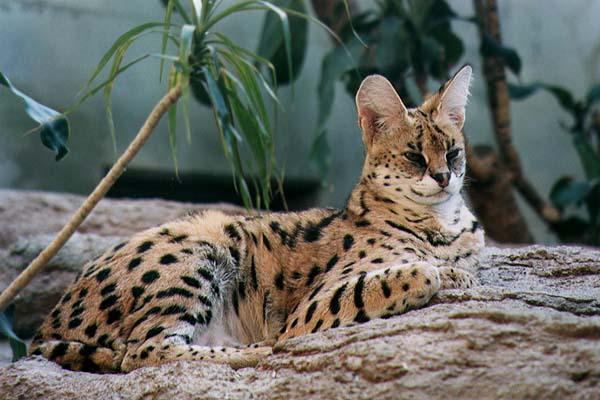
Serval
True Wild Life | Serval | The serval is a medium-sized cat that is found in parts of central and southern Africa. The average serval tends to be around 80cm in length but it is not uncommon for some adult servals to grow to over a meter in length. The serval has a spotted pelt like a cheetah and the serval also benefits from having astonishingly good fan-like ears which enables it to hear enemies and prey. The satellite dish ears also allow the serval to sense vibrations.
The serval has been extensively hunted across Africa for its fur meaning that some serval populations have become extinct. Today the serval is rarely found north of the African Sahara Desert and the serval is extinct from the southern Cape of Africa but the serval is still common is western and eastern parts of central Africa.
The serval hunts hares, birds, reptiles, frogs, fish and larger species of insects but the serval has also been known to hunt larger animals such as antelope, although this is uncommon for a servals normal diet. The serval eats fast to avoid losing its meal to larger predators. Servals have incredible leaping ability and can grab birds out of the air.
There are thought to be around 10 different subspecies of serval still found in the African wild, with there also having been sightings of albino (white) and melanistic (black) servals. Of the two, blacks are more common. The serval is thought to be most closely related to the caracal and the African Golden Cat that are found in similar territories in Africa to the serval.
The gestation period for a serval is a little less than 3 months after which time, 2 or 3 serval kittens are born although servals have been known to have as many as 5 kittens in one litter. The tiny serval kittens are born blind and their eyes are usually fully in open within 2 weeks. The serval kittens remain with their mother until they are about a year old and are big enough and strong enough to look after themselves in the African wild.
Sunday, March 13, 2011
Puma
True Wild Life | Puma | Puma is simply another name for a cougar and therefore one of the largest and ruthless members of the cat family in the world. The puma is native to the Americas and can be found from Western Canada, to the Andes mountain range in South America and all along the west coast of North America.
The puma is a solitary mammal and will compete for prey with larger predators such as wolf packs and bears. The puma hunts deer, elk, beavers and other large mammals and the occasional bird.
Pumas tend to be tan or brown in colour and their size is often dependent on the area in which they live. Those pumas found in Canada and North America are generally slightly larger and have thicker fur than the pumas found in South America, as the uncompromising winters mean that the northern puma must have more defense against the cold.
Pumas are highly territorial and tend to be found in mountain ranges and in some areas where there is dense, undisturbed forest. The puma population day is declining mainly due to habitat loss.